With zero wind experience I’d recommend you take a couple lessons locally. That will be money very well spent so that you can be a little more informed about your purchase decisions.
1 Like
It comes down to the perspective of who is giving opinion. From a DW perspective, it’s all about stashing. Even more so if you’re blessed with DW logistics options.
From a wing alternative perspective, where you have to earn your downwind, then gust handling ability and upwind abilities are absolutely critical.
100% dependent on what’s happening in your local scene, hence the full spectrum of opinions.
1 Like
for DW, in our area, lots of people just need to pull themselves on foil. thats all. they can stay on foil until they get to their exit point and shuttle back. even north ranger would be sufficient for that purpose. However, if you want or need to come back to the origin point for lets say five miles upwind, then its all about the max upwind angle and comfort.
1 Like
I can’t wing. I have had probably 6 failed sessions where I can’t seem to get on foil. I can prone and FD. No wind experience at all. Well I decided to get a parawing with the Black Friday mackite sale after hearing people say to go for it- ended up with an ensis roger 4m. Been out one time and instant tangled mess. I never hear anything about the ensis so maybe they are no good. Especially for beginners. Regardless I am very discouraged about PW at the moment
Here is my thinking behind suggesting the Ka’a :
- Everybody that start parawinging will struggle. It’s normal, its part of the game and you should embrace-it.
- You will still struggle even with a slighly less or slighly better parawing. It do not matter as long as you have the correct sizing. About sizing, more sail is always better to learn on then less sail.
- People tend to wait for the perfect parawing and the perfect price. I say, buy a second hand parawing that is cheap and perform just ok. It do not need to be the best/newest one. Just start doing the thing.
Here is my recommandation on different model :
- Of course, if money is not an issue, buy the best one for learning. I too suggest the F-one Quest.
- If money is an issue, buy a second hand parawing. Here’s the more common one : Ozone Pocket Rocket for a better sailing experience, the BRM Ka’a for better stashing experience or even better, a BRM Kanaha for a super good all-arounder. The BRM Maliko v1 with the bridal AND the bar modification is also a valid and super cheap options.
Taking a lessons is also such a great advice. I forget that its now even possible.
The key point is : you will struggle so start as soon as possible !
I hope it help and do not confuse you more.
YEWWW !
3 Likes
Had a couple friends struggle on the Ka’a.
When learning, I had the Gong, KANAHA, & Maliko; I could ride on my knees taxiing and zip right up wind, no proble. I grab a buddies Ka’a to see if it was him or the PW…. I couldn’t knee ride up wind either. He sold it that day, got the f-one and was riding the next session
I would use a Ka’a now for DW runs and easy pack. I wouldn’t teach someone with that PW
3 Likes
Well, I was wrong then. I always assumed the Ka’a was better in every way than my Maliko v1.
I guess I was talking a bit out of my ass about the Ka’a.
I’m a bit surprised no one advised to buy a used inflatable wing to start with. If I had zero wind sport experience I’d think it would be easier to learn on a normal wing and then progress to a parawing. Or am I missing something? I’m of course biased from my own experience learning on a rigid wing and then transitioning to parawing.
1 Like
Thank you for the advice! What size Parawing would you recommend? Yea I’m now leaning towards a frigate or quest seems to be more user friendly options
What about using a paddle board to start to learn how to taxi around and take the foil out of equation?
I actually missed the zero wind sport background. If you embrace the struggle it’s doable, but winging first will be a lot easier. If you decide to pw anyway, I’d think a big midlength (+30-40l) is far better than a dw board, which would be a struggle to balance on. I hated learning on my dw board, far easier with a midlength. A user friendly parawing will be even more important and I’d be even more inclined to recommend a Quest, probably in 4,5m for your wind.
Judging from your name I’d go straight to a ~100 liter board with the foil attached. Then start with a 5-6 m wing. Better to be a bit overpowered to start with and then downsize, or maybe just switch to parawing at that point.
While it might be a little bit easier to learn to wing first you are still wasting a bunch of time learning non-transferable skills and you’re better off just putting that time in to learn to parawing if that’s your goal.
My advice is to buy a parawing that slogs well and a +10-25L board in the 20-22" wide range. Then even if you are struggling to get on foil you can still stand there and easily slog upwind.
Examples of parawings that slog upwind well:
- Frigate (the best upwind slog I’ve seen)
- POW
- PocketRocket
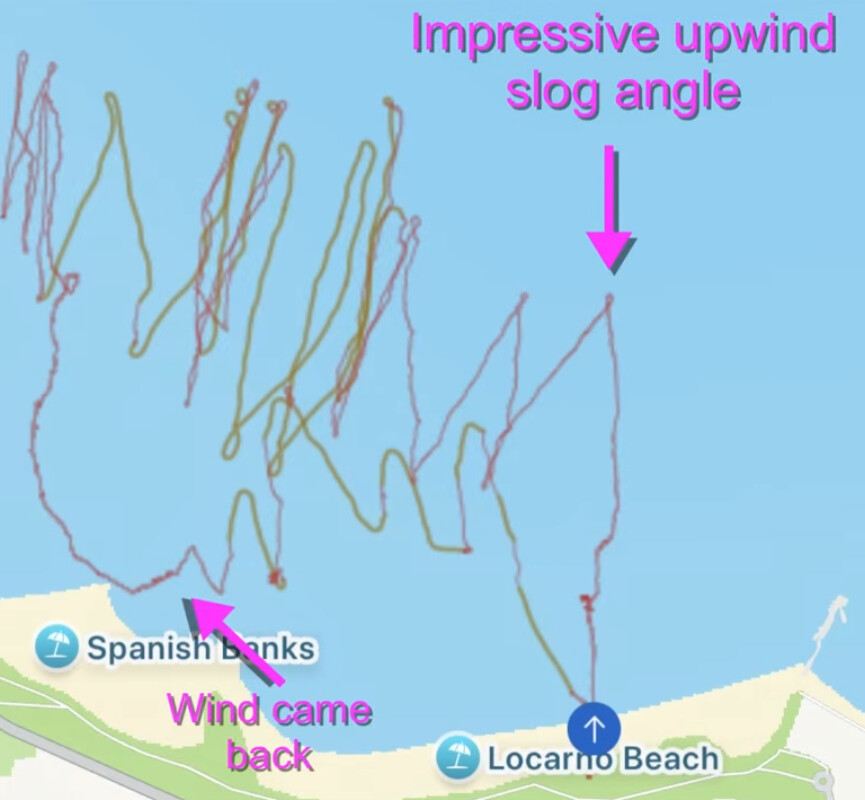
Here is an example of a session that was 7-9 knots most of the time, red tracks are not on foil, 4.7m Frigate +20L board, there was a bit of a falling tide helping my upwind angle as well though:
Sold an Ozone Pocket Rocket to a guy yesterday at Crissy Field - his first parawing. Gave him a 5 minute crash course on the grass, and to my surprise he said he planned to go out right then.
I told him to be careful, but he was also young and fit, and had a a strong waterspouts (kite/wing) background. I was skeptical so told him I would keep an eye on him, despite the mild ebb and strong wind.
He ran about 300M up the beach with his board and new to him parawing. Immediately got to taxiing for about 60 seconds, and then to my surprise was up and riding!

I also think LaPaloude is dead on that a lot of beginners let perfect be the enemy of the good in terms of shopping for their first parawing. I would estimate that the typical early adopter of parawing is getting 50-100 water days per year, but that this second wave has many more folks that may only get 25 water days per year. If they dedicate a third of those days to parawing … are they going to progress fast enough to ever notice the upwind differences between these various models?
2 Likes
If you’re young and fit, with a decent foil background, good wind and not too chaotic conditions, with a big enough board, and a big enough foil, then it’s pretty common to be up and riding on your first day.
I started on the water with a -10L ML with a Hyper2 190 foil, which is/was my “big” lightwind wing gear, but clearly not “big enough”. And being over 100kgs, I needed a fair bit of wind (about 18-20kts) to get going with a 5m, (and then fell quickly overpowered/out of control once on foil), and all the getting up and pre foiling stage was actually brutal because of the chop and conditions that come with that much wind on my spots.
Really a big board makes a hell of a difference, as it allows to get going in lighter winds where the sea is smoother, and also provides extra stability which is very valuable, as every time you fall and get back up takes a fair bit of energy (that’s where the young and fit part applies)
I think PW is the most demanding in terms of gear, you need the right everything otherwise it’s a punishing struggle whereas on the wing, it’s kind of easier to … well, wing it.
And on a side note, don’t start with a Takoon Zenith
2 Likes
Can anyone comment on the ensis Roger?
Word on the street is twitchy and not great.
By today’s standard the v1 is shit, v2 is supposed to be okay I guess. IIRC Ensis were the second brand to launch a parawing after BRM, so not strange that they didn’t have time to work it through as well as some later releases.
Which Gong did you have? What generation?
It was the Gong Plus v1 5m. Wind range is limited (13-17mph). Strong low end. Thick material, longer lines, harder to stow. Goes upwind well. Honestly it was great for my first 10 sessions
1 Like