Axis Fireball Range vs. ART Pro?

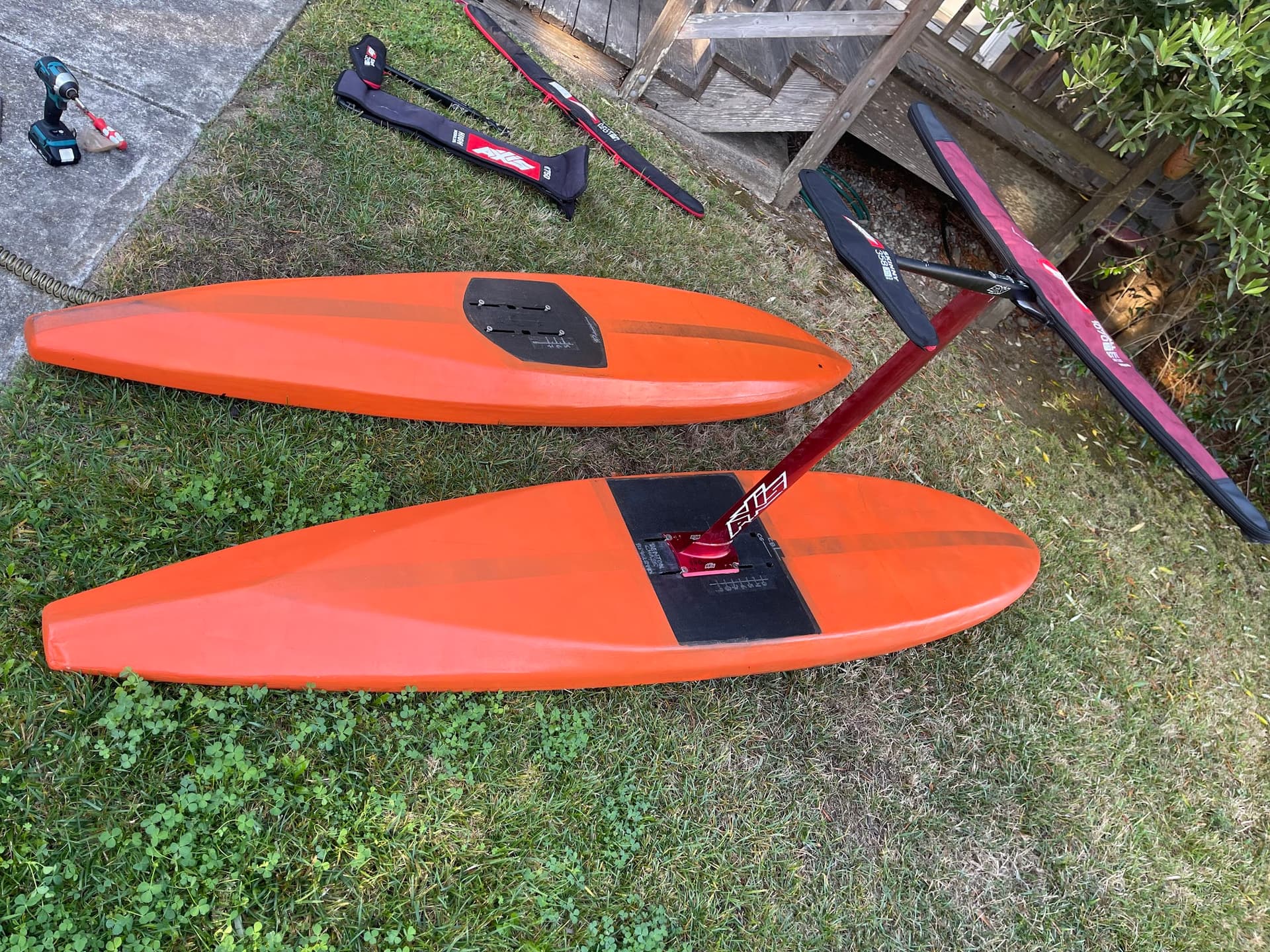
I have been hammering away on the 1070 Fireball in Northern California. No wind but long rides in small to medium sized surf and semi-open ocean (2 - 8 feet). I am riding an 8’ 8" x 19" board when its ‘clean’ and a 10’ x 23" @ 150 liter big wave gun when its nasty.

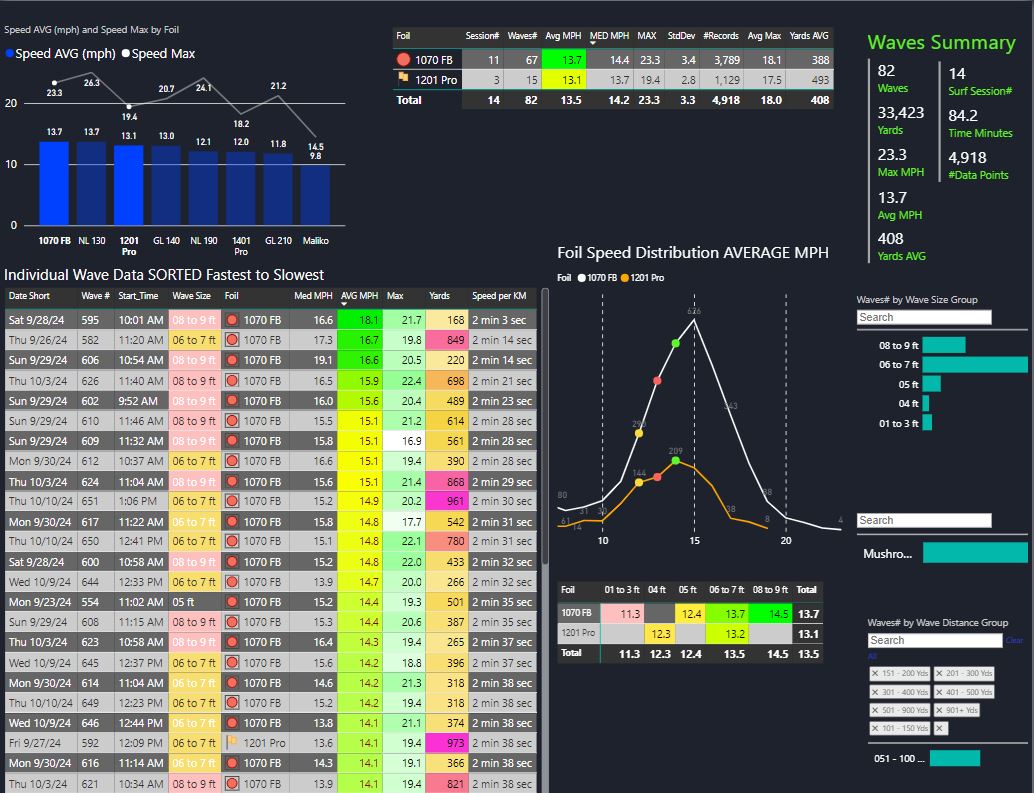
My conclusion: The 1070 will hold speed. It can comfortably maintain 15 - 17 mph which ranges from 2:15 to 2:30 minutes per kilometer This reinforces that the Axis 1070 is a high aspect race foil. One of the local pros used it in the Maui to Molokai race this year.

It is harder to paddle up. I can flat water paddle up on the 1401 and the 1201. I typically ‘never’ miss a wave with these bigger foils when it is small and clean. However I have been missing nearly 50% of my takeoffs with this foil. It is half the size of the 1401 and half the weight. I have been running a 90 cm mast to accommodate the lack of stability on takeoff and going into areas with steeper takeoffs aka re-learning how to takeoff.

I often bring 3 foils to the beach and will switch out if its too small, or too fast for a certain setup. I have been running the Fireball with an Ultra Short 640 mm Advanced Fuselage and a skinny 35 tail.

The ocean usually determines the speed with the fastest speeds the can come on a bigger steep wave face during takeoff or when the wave passes back into deep water and speeds back up again.

The following data was exported from the Waterspeed app. The distribution curve shows the range of data collected. What you can see is that the peak for the 1070 is @ 15 mph. The 1201 is @ 14 mph. And the distribution for the 1070 extends far to the right meaning MORE high speed data.
6 Likes

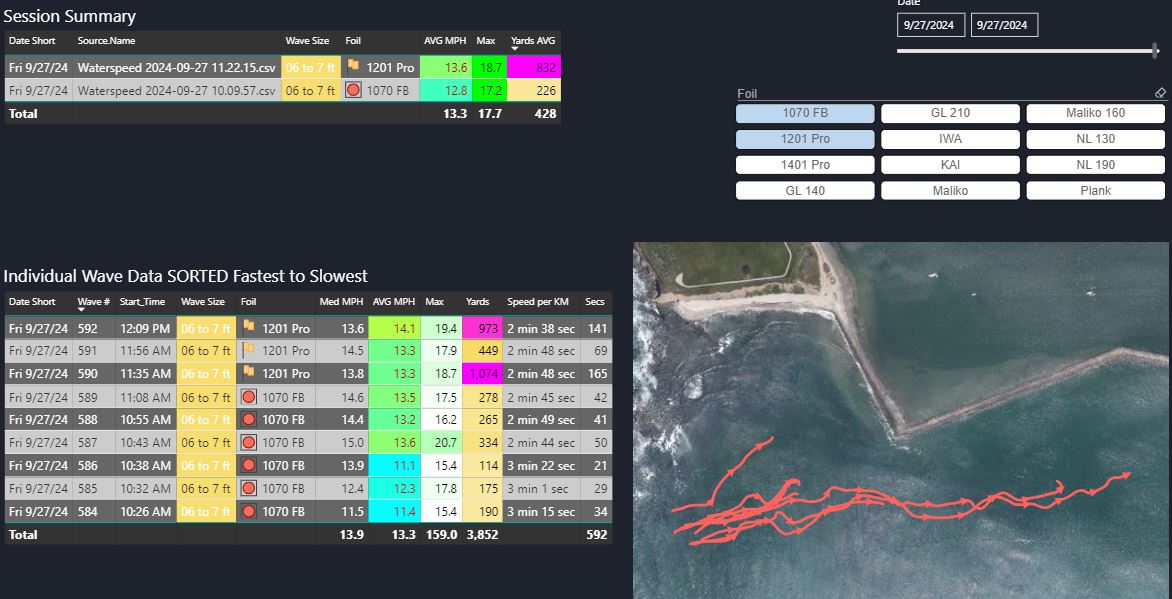
Here is an example of the Ocean determining the speed.

On Sept 27 I started on the Fireball. Wave faces were estimated @ 6-7 feet. However I wasn’t feeling the love from the Fireball and was NOT able to get further than ~ 300 yards. I switched out to the 1201 and the first wave was 1,100 yards. And it was relatively fast.

The average speed was higher on the 1201 and the average wave ride was 3X longer. The conclusion is that each foil has its place*

*These stats were all within the first week of using the 1070. My pumping on this foil has since improved but is still not up to the level of the 1201

6 Likes

@Beasho , thanks for the info. Could you clarify the fuse? 640 Ultrashort or 560 Sillyshort?
Thanks.

Yes 640 Ultra Short Advanced (not plus) with Fireball and 35 tail.
I’ve been using the 560 Silly Short Advanced+ with the 1201 and 1401 preferring the 40 tail.
I have been looking for the pitch stability at higher speeds with the 1070 fireball.

I may have to start testing the Silly Short when it’s on the smaller side to get the pump working.
The advanced + fuse added significant pump ability to the 1401 and 1201.

3 Likes

I rode the Fireball 1070 and the ART Pro1201 back to back today (along with the Fireball880, hps930, art1099.) Great day!

Stats: I’m 160lbs, advanced foiler (4yrs winging, 10yrs foiling/racing, 20yrs kiting), wind speed 15mph, I rode each foil for 30mins, wing 4m takoon v2, board 85L AFS whitebird, mast 90cm power carbon, fuse ultra short adv+, tail skinny 40. I only switched the front wings and the wind was a consistent ocean breeze.

In my opinion, the 1070 is not a replacement for the 1201. I have an ART 1099 that I ride 3 to 5 times a week. the way I can best explain the Fireball 1070 is it’s a WAY better art1099 (way better turning, breaching, bigger speed range top/bottom, better early lift, and lower stall speed.)

If the fireball range was available vs buying the art1099. I would go Fireball 1070 100% no question.

If Axis comes out with a fireball in the size range of the 1201, Im pretty sure I would prefer the Fireball. It just seems to improve in most areas of the ART and Art Pro foils.

The Axis website online brochure rates the foil attributes using dots (with way too many dots to count btw) but those dots are quite accurate compared to what I felt on all the front wings today.

Also, the 880 fireball would probably replace my 699 and 899. It has the speed of the 699 (I didn’t find the top end and hit 26.4mph before there wasn’t any more wind in my wing), with slightly better take off speed than the 899, and way better turning than both.

P.s. Axis please please retire some foils for our sanity. Haha. Cheers all!

3 Likes

I have to disagree with you, David—you’re more than just an advanced rider; you’re basically at local legend status!

As for the Art Pros, I’m a big fan. I was able to add a shim to get a bit more glide out of them, and it made a noticeable difference.

After spending some time experimenting with the Fireballs, I found that they perform well without needing a stab shim.

1 Like

I’ve been on the 1000 and surprised by how comfortable it is at very low and high speeds. The turning isn’t amazing, but it is very efficient.

Something on the masts, I haven’t confirmed this by testing myself, but spoke to a variety of pros and they all suggested going <80cm for masts, and all raced on <75cm in very light conditions as it made the paddle ups and pumping easier.

I can see how the shorter mast brings the foil more quickly to the surface where there is more energy, and also how it quickly will reduce drag as you get on foil. Only downsides seem to be more likely to breach, and more responsive/twitchy

Ironically I am now suggesting (?) BACK TO ALUMINUM.

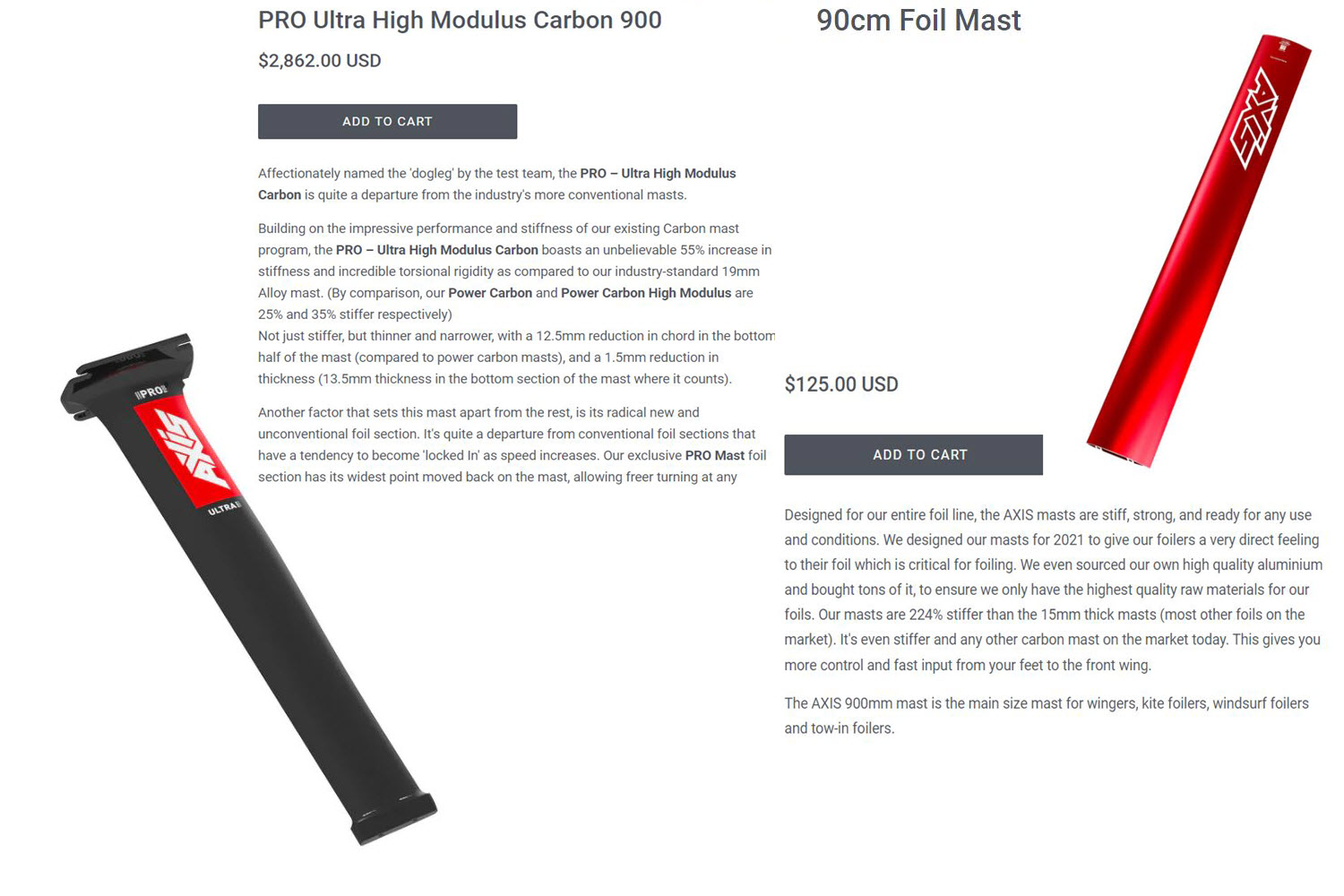
I was borrowing an Ultra High Modulus 90 cm from the local Pro and he wanted it back for winging. So I retrograded to the 90cm Aluminum mast. I switched from one day to the next day and found:

  1. No apparent downside in speed (for my conditions see below)
  2. No noticeable downside from lack of stiffness or wobble

On the topic of length: both 90cm mast provided these benefits

  1. The problem of breaching the front and rear wing immediately disappeared (vs 75cm Power Carbon)
  2. In bigger open ocean swell conditions the energy runs deeper meaning there is less need to run deep or ride high on the mast to gain efficiency and more generally available power to tap into.

2+ years ago the Axis 19mm Aluminum mast was a hallmark of stiffness. When Axis introduce the bigger foils aka 1401 Pro (1611 cm 83% bigger than 1070 Fireball) they recommended running the Power Carbon, then the Ultra High Modulus. However!!!..

These new foils are half the size, and half the weight. Their influence on the mast from Torque and tip twist (think tiny tips) is significantly reduced. The local Pro was introduced to the Ultra High Modulus 1 year ago and said he noticed a great advantage when turning, even with smaller foils, in the Gorge. He also suggested that he would benefit from the Chord and efficiency when pushing from 40 - 50 miles in open ocean runs but OTHERWISE the Aluminum works well at 5% of the cost. AKA save the money for foils, try multiple another mast for less than you would pay FOR TAX on the Ultra High Modulus. Next up the 105 cm Aluminum that I had sitting around collecting dust.

Note: The conditions I am typically riding in are NASTY. Cross currents at the tip of Pillar Point (Mavericks), reverb chop off a Jetty wall and the rocks at Mushroom going every direction. The waves (in winter) are rarely smaller than 6 feet @ 10 seconds meaning its BIG, fast, but because of the rock reef waves can be soft, mushy at the top or not breaking at all in certain spots. 99% of the time no one comes out with me to foil, other than on Jet Skis, when the conditions are medium to big. The longer masts act as affordable, modular stability for the downwind boards.

3 Likes

Off topic, but since you brought it up.

I did an A/B test back to back about 45 minutes in the surf each for axis aluminum mast and axis power carbon high modulus. Same length.

There is no similarity for me. The aluminum is noticeably more draggy while pumping, I can’t tell on the wave, but pumping in flat water it is immediately noticeable. The high modulus mast is noticeably more stiff and this is apparent just standing on the board, but especially taking off and riding waves. Not a problem with the aluminum, but the stiffer is better for me.

John: What foil were you testing the Aluminum vs Carbon?

I am not debating that the Aluminum is as good as Carbon, but as the size of the foils come down the stiffness and frankly the efficiency of the mast become less critical. For example the difference between a 50 skinny tail, and the 35 skinny tail MAY have a bigger impact on drag than the Aluminum vs Carbon mast.

Most of us started with an Axis Aluminum base and doodad, so the cost of an additional Aluminum mast is $125 vs $2,862 for the UHM mast (90cm in US). That is a 2,290% higher price. The extra $2,737 could go a long way to finding other ways to improve efficiency.

1 Like

Argument to be made for the opposite (better than I will here): as the foil gets smaller the mast becomes higher % of total drag.

I was fine on axis Alu on the older gen foils but now am constantly seeking less drag.

Agree that alu is good value, but I don’t see what you’d spend that $2,737 to improve a high performance setup? (other than a new board, or an efoil?)

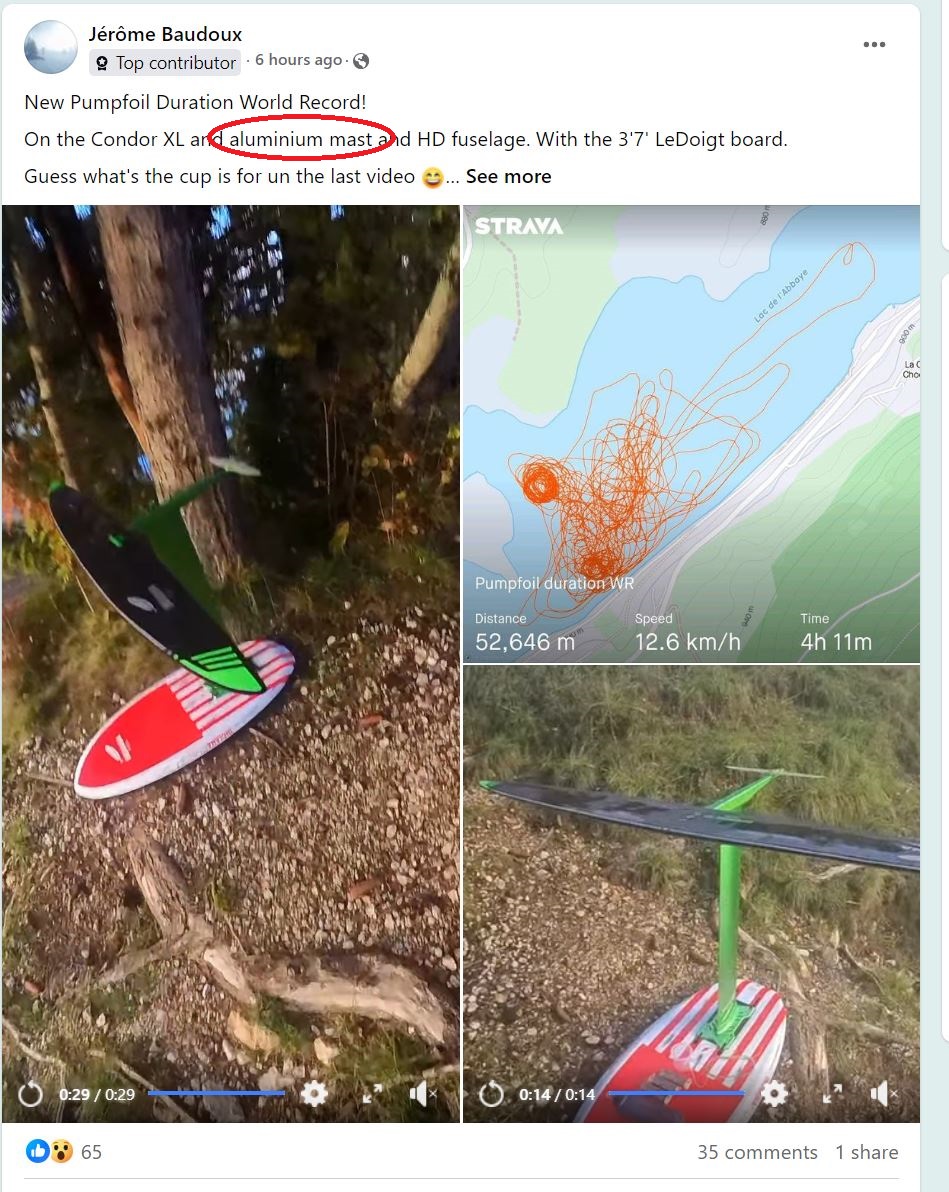
How timely. This guy claims to have just set the pump world record with . . . . an aluminum mast!

4 Hours 11 minutes, 52.6 KM.

Imagine how well he could have done with a carbon mast :slight_smile:

1 Like

fwiw, another lake pumper

The alu masts were less stable, less efficient in my experience, and I won’t buy another to validate that experience, and the ones I have would all need to be welded at the fuse to make a useful comparison as the doodad/mast/fuse interface is all bent out of shape.

Have you tried Art v2? I’m on 899 and 999 art looking for a new foil for winging (no jumping) tossing up between Art v2 (939) and Fireball (1000).

I’ve been trying to figure out how to compare across just 6 of the Axis foil ranges (41 Front Wings.) Axis, PLEASE retire some foils!

I’ve been testing so many Axis foils and racking my brain how to classify the differences. Then I realized the Axis brochure shows each front wing and its attributes. They use dots, which is super annoying, but they seem to be quite accurate! So, like a good engineer I made a table!

Front Wing Attributes from the attribute dots in the Axis online brochure:

Attribute Fireball ART V2 ART Pro ART Spitfire HPS
Stability 9 7 7 7 9 9
Turning 8 12 10 5 10 8
Speed 10 12 10 10 10 9
Lift 11 6 6 6 9 8
Glide 10 11 10 10 8 10

a few notes:

  1. The HPS is the only one that seems a bit overrated by about 2 pts in Speed and Glide.
  2. The attribute ‘Lift’ seems to be talking to ‘low speed lift’ or how low the stall speed is.
  3. Maybe lift+speed+stablity = speed range?

Once you pick the attributes you then tackle the size. This is a whole different ball of wax to compare across the ranges. Any ideas on how to make a table for size comparison across the foils? I was thinking we base it off one foil range, like the ART, then give the +/- to the wingspan or area of the other foils. like ART 1099 as the base, then to select a Fireball equivalent would be -30mm.

ART 1099 899
Fireball (approx. -20 to -50mm span?) ~1070 ~880
The tricky part is the 880 seems to me to have the lift of the 899 but speed of the 699. The 1070 has the lift of something larger than the 1099, but the speed of something between the 999/899. ugh. *CRY*

ANYWAY, to answer your question going from 899/999 to Fireball or ARTv2. I would say do you want more speed/turning and are okay with the same lift/stability of the ART then go ARTv2. Or do you want more low-speed lift, stability, with slightly better turning and a wider speed range, then go Fireball.

*** This is for fun; I sincerely hope I don’t mis-represent anything here! Please let me know if you see any issues! Also, this might need to be a new thread, I’m not sure. ***

4 Likes

Thanks for connecting the dots. This is a lot easier than looking in the brochure.
I just ordered an art v2 999 and a fireball 1070. Come try them in Ft. Pierce this weekend!

2 Likes

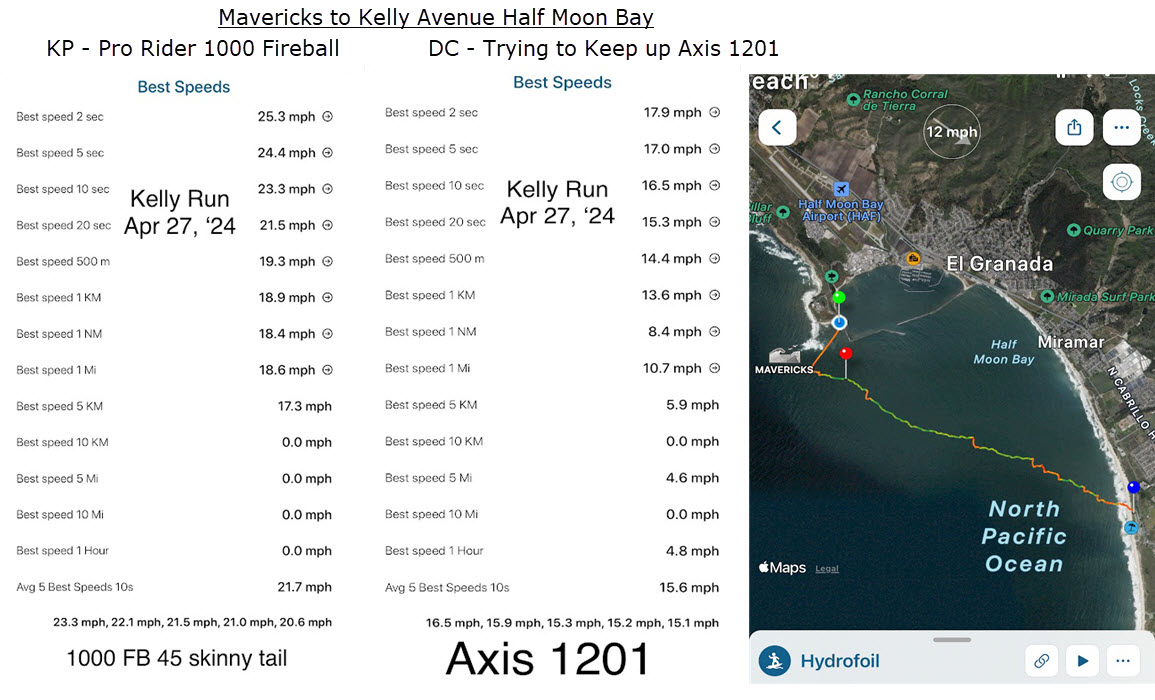
Comparison of Axis Fireball 1000 vs Axis 1201

Same day, same run—4 miles downwind from Mavericks to Kelly Avenue in Half Moon Bay, CA. The Fireball 1000 was ridden by a pro, while I was on the 1201, struggling to keep up. The conditions were technical, with 7-foot swell at 8-second intervals.

Kyle, riding the Fireball 1000, was impressed by its speed and maneuverability, able to glide effortlessly at oblique angles without losing speed. Meanwhile, I had to continuously drop back to stay with the swell. Data showed the Fireball 1000 was about 40% faster over all distances measured.

What surprised me most was hitting 21 mph for 20 seconds on 8-second period swell—an impressive speed for unpowered foiling (aka no sail), typically achievable only with bigger waves or longer periods.

2 Likes

No idea if you miss copied from the brochure or not but this table doesn’t make sense.
for speed it goes:
FB → AP → A2 → A → SF/HPS
for turning it goes:
SF → A2 → HPS → FB → A → AP
for glide it goes:
FB → AP → A2/A → HPS → SF

2 Likes

I’m guessing that the ratings for HPS and ART were relevant when they were released, not so much years later.

I’ve had 10+ sessions on the fireball mostly prone and I think this is my summary (40 skinny, shortish fuse)

I haven’t ridden an equivalent DW foil from any other brand, so this is PURELY relative to the rest of the Axis lineup, primarily 1121

Good

  • Fast - definitely the most effortless foil when up to speed I’ve ridden, really stable going super fast, never an issue with overspeeding
  • Low end is great, really easy to get it going and pretty clear when it is going to stall and easy to recover
  • Efficient - quite surprised how little bump energy it needed to feel some glide, and AMAZING how flat the waves can be when you link into them, this is really good, just effortless to get up to speed with swell that in the past I wouldn’t have linked into
  • Breaches are really good, I didn’t realise it but I was breaching the tips a lot, and had put it down to pitchy feeling until a friend pointed out the tips were way out. Once I realised this, I could poke them out on pretty flat turns, it’s super smooth

Less good

  • Turns - It is hard work to get it from rail to rail. This is what you’d expect from a high AR, but also through the turns it is pitchy and requires very active balance to keep it smooth and flowy through the rail transition. Lots of hands flailing and hips moving.
  • Turbulence - I could not punch through waves like I could on the 1121, it was just too sensitive, and it gets easily wobbled and stalled by chopped up surf. This will be a problem for me through the winter

I do think this Fireball as a sensible “ART v2”, it reminds me a lot of the original ART (fast, efficient, hard to turn) and I think it makes sense as an upgrade with massive refinements from those… or call it an ART Pro, because it’s m… oh wait :joy:

I will probably try compare it more to the actual ART V2 soon, but I’m happy with this for DW, but doesn’t really make sense for prone

Edit - just had an absolute nightmare session on the SUP in the surf, very sensitive to a badly placed mast and shim setup, impossible to work around. … just what I get for writing up a review

3 Likes