There’s so much going on in this thread, it’s really interesting and entertaining. I’m admittedly an idiot so I am curious am I the only one who moves their mast several inches regularly?
Let’s say 0 is center, negative is forward and positive is back. Lately I’ve been using one board for all my winging from chest saltwater waves to 12 knot lake, learning to parawing and sup surf foiling. For example:
12 knot lake winging -2"
18 knot lake wing 0
25 knot lake wing and all wave wing +1.5"
All parawing -1"
Sup foil surfing +1"
Am I alone and dumb for this because it feels great to me and super helpful to get more out of the same board.
Separately I do not understand the concept of holding the foil upside down with the board attached to find the “balance point”? That’s just a random point of equilibrium that doesn’t take into account your foot placement, the placement of the pad. Do you keep the leash on? That certainly adds a few grams? What if you replace the traction? I just don’t understand what it measures.
We need to know the span difference and foil profile differences of the 600 to 900 cm foils maybe it’s not the Tuttle but the foil
Thanks for your help.
Oh and what do airplanes have to do with this? Last I checked I want my 747 flight to be flat and smooth, not railing turns and doing carving 360s on the edge of barometric pressure change.
I move mast position similarly to you but I’m also an idiot. I’d say three main reasons for me:
1- small movement plus or minus 1" ish for different conditions or disciplines for example prone foiling or kite foiling the exact same board and foil I used different mast positions.
2- different fuse lengths / stabilizers changes in those can change where you want your mast a bit
3- different brand foils/ sizes of foil this is where it’s the biggest change .
I’m down to only have let’s say ±2" of adjustment as long as the center is in the right place which board builders should be getting right . So don’t have to have let’s say 16" tracks , those seem absurd. BUT for me as much as I’m sure Tuttle is slippery/ light/ cheaper to build right now the adjustability of the plate wins as the “best wrong answer”
I was feeling very anti all the "performance " talk when it seemed like arguing over numbers because for the 99% of us that aren’t competitive foilers in any way it seems like "performance " should be measured by feeling and ease of use . And as much as I get a rude vibe from @Beasho . I like that you brought up the example of the wingers being able to get up easier / size down equipment, that is a serious "performance " gain towards having a better session.
Conditions is probably the wrong word. I’d say the prone in the surf vs kite foiling the exact same setup board and foil is more of the scenario I’m talking about.
I’m not planning to pump at all (kite foiling for example) or if the waves are head high and the drops on the chips are kinda gnarly on a foil I’d move the mast back up to 2" same exact board and foil where 2" forward would be the setup for a small groveling prone foiling without a power source day.
This is typically on a very small / lightweight board so even though that 2" seems drastic it is isn’t that noticeable for swing weight or balance difference. And my stance front to back on the board changes for sure so it’s almost sort of a comfort / thing.
on a small light board, sometimes gaining some swing weight by moving the mast back is actually a bit of a cheat code for controlling harder turns, this is a way to add dead mass in front of the foil similar to how people talk about longer or heavier bigger board feel like you can turn harder because the board helps stabilize the system and smooth things out .
If you are dialing for pumping efficiency many times it feels more efficient to move the mast forward to do the opposite with the swing weight and look for that neutral balance point.
also if you are messing with stabilizer angle, this can be a factor in mast position. For example tuning so that you can move you mast forward to put the pivot point of the turning aspect of the masts impact on turning is a whole other idea. I’ve moved away from non monobloc stabilizers though so I don’t have the luxury of changing angle. This is because I found that one piece monobloc stabilizers are twice if not more better at not snagging seaweed and I have to deal with so much seaweed it matters
if I didn’t have to foil in seaweed regularly, I would prefer the adjustment options of separate stabs. I know there are systems where you can adjust angle even on a monobloc tail so that is interesting to me
I fully understand the discussion about tuttles isn’t focused on kite foiling or prone in the surf boards so a lot of my comments above is not that important for the debate . Although I have to imagine a lot of folks want to have more adjustments than is available easily in a Tuttle.
What is the most adjustable Tuttle easily accessible for board builders currently? How long is the adjustment?
Imagine if you were clever enough to substantiate 2 to 3% less overall drag when the board and the tuttle is in the water. Then you would actually be able to say Dave is contradicting himself.
Of course a tuttle is more efficient but on a sup with all the surface area and drag, its like trying to get more aerodynamic mirrors on a truck to save on fuel. of course the mirrors have heaps less drag but so what.
Kite foil boards have less than half the area and more than twice the takeoff speed of a DW sup so its no accident they stuck with tuttle. Not to mention they have no requirement for adjustability.
Hahaha be careful I didn’t say that technique is wrong I said I do not understand it which is quite different. If there’s an easy explanation I’m all ears but removing the water and rider from the equation makes it fall apart for my comprehension.
You bring up a great example I believe they make the same boards in different constructions so I’d be curious is the weight distribution exactly the same on both constructions? If not do you move your mast position from one to the other? Meaning that you have the same board but two different mast positions…
Your center of buoyancy calculation makes sense to me if you want a fixed position and is a great technique. My personal riding and use isn’t fixed but if it was center of buoyancy makes sense. But kanes video doesn’t help me wrap my dumb brain around foil/mast/board weight air equilibrium.
I don’t think there’s much debate that Tuttle is a better system. The real question is whether the average rider will actually feel the difference—and that comes down to skill level.
There’s a reason you don’t see plate mounts in high-level competition. In PWA foiling, it’s all Tuttle. Blue Planet had a solid discussion with Mike from Mike’s Lab on this, especially around construction advantages—cleaner carbon layup, better resin control, and overall strength. Remi from Starboard has also talked about this in past podcasts, referencing extensive internal testing. Same with Chris from F4 in multiple interviews.
At the end of the day, the only real advantage of plate systems has been adjustability.
That brings me to something I’ve been wondering about: the adjustable Tuttle boxes. Comparing one of those to a Seatex box I have, the adjustable version looks noticeably narrower and less robust. It doesn’t inspire the same confidence structurally.
So I’m curious—are these actually suitable for wind foiling, not just winging? Wind foiling introduces more lateral load, and I’m having a hard time seeing how the shim-based adjustment system holds up long term under that kind of stress. Traditional shimming of a Tuttle mast isn’t really about handling side loads so it’s not quite the same thing as relying on a fully adjustable system.
Genuinely interested if anyone has real-world experience with these in wind foiling conditions.
Also, I’ll restrain myself from posting any more links to new specs from Ken Adgate (Slingshot)… apparently that earns you a timeout. The moderation system is a bit of a mystery—I was actually on hold for two years, just assumed that was normal. One day I finally asked a moderator what the hell I needed to do just to participate.
Nah, talk about slingshot. I’ll complain to the higher ups to get you unmuted if I see it. Mostly they just use AI to read the message boards. I’m the real person you can talk to.
If anyone in the Hood River area wants to go back-to-back on Adjustable Tuttle vs. Tracks, I have a 65L Hydrocraft board equipped with both. And a Tuttle mast and a plate mast in the same layup, so you can test them with the mounting system as the only variable.
My Takeaways:
Feel: I wouldn’t say the Tuttle is “worlds stiffer,” but it does provide a more connected, direct feel through the board.
Drag: The biggest difference is when the board is low to the water during turns. It’s a touch smoother because you aren’t catching drag from the mast flaring out into the base plate.
Versatility: Is it going to turn the average rider into Ken or Johnny? No. I think most riders will probably benefit more from the adjustability of tracks.
If you’ve dialed in your foil position and want maximum efficiency, the adjustable Tuttle is a damn cool piece of kit. It’s a cleaner, more streamlined system for those who know exactly where they want to be.
DM me if you’re around the Hatch or Event Site and want to swap for a few laps!
I haven’t tried the Seatex box, but it looks like it relies on “tubes” going up from the actually tuttle recess to the deck.
The adjustable from tuttlebox.com carries the sidewalls all the way through as a full I-beam to the deck and you are through-bolting your screws straight from the deck plate.
I think the I-beaming is significantly more important than the width.
I don’t windfoil, but at 130kg and 6’6" I’m pushing some serious loads. I have three boards with the adjustable box (two of which I’ve installed myself) and will say it’s the stiffest I’ve tried. It’s excellent.
As for adjustment, it has 2" fore-aft range, and +/-2º angle. More than enough.
My understanding is that the “balance method” for foil placement is using mass (weight) as a proxy for volume. The purpose is to center the lift of the foil with the center of volume. It generally works for me, but “level” is a pretty imprecise term (is the bottom level, the deck, etc…), and you can’t really eyeball differences in how “level” the board is even if you move the foil a little forward or back. I see it as a starting point for further fine tuning, and its generally within an inch of what I like.
What I took from Adrian’s interview was that the standard Tuttle system also run’s into limitations on the ability to maintain stiffness to lateral and torsional loads, which is one of the benefits of a Plate or hybrid system. Less of an issue for the 600-800sqcm rider, but there’s lot of folks that want to ride HA wings that are 1000-1,200!
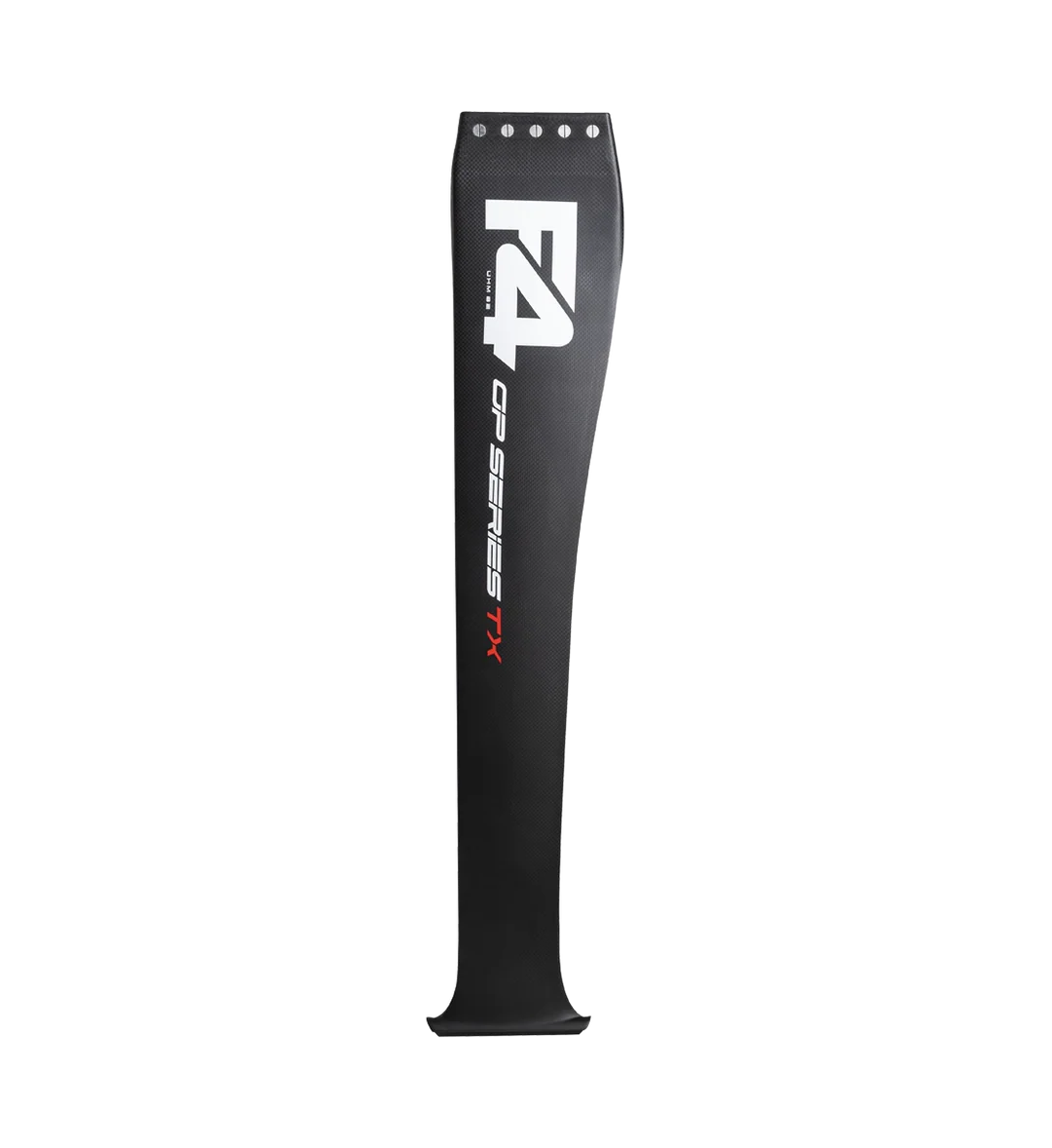
This looks really pronounced in the latest F4 UHM Tuttle mast for wing foil / downwind, and I can see an argument that moving as much of that material away from the foil makes sense (in addition to adjustability). A potential benefit of the Adjustable Tuttle is the ability to actually cannibalize some of that spacer length for an even wider tuttle interface at the top.
I don’t know why Tuttle-champions are surprised mass market consumers haven’t adopted Tuttle yet for wing foil and downwind. The options just aren’t there yet.
DownwindBoards: No major manufacturer today. Wingfoil/Parawing Boards: No major manufacturer today. Masts: No major manufacturer today.
I think we are on the cusp of all of that changing … F4 could produce a smaller/narrower Julitta and a non-UHM mast. To me it feels like Slingshot will be the first to market with an affordable turn-key Tuttle board and mast in dimensions that early majority want to ride.
Up until now it’s been a fairly intimidating prospect - wait 12-18 months for a Mikeslab or modify a plate mast (!); then take a gamble on a custom board or make do with a dated wing foil race board. Not to mention the huge risk you would take mixing and matching the rare Tuttle wing board / Tuttle foil set wrt the box locations.
That would be an interesting comparison. It would be hard to back to back the differences in board design for plate vs tuttle. What immediately stood out to me looking at a buddy’s F4 wingfoil race setup was that the tuttle mount does not require a big flat spot on the bottom of the board.
I keep meaning to write up my latest findings on adjustable tuttle boxes. I have made several of them now. I have no interest in making and selling them to be honest, but I’d love to get the information out there so someone else can make and sell them. I did make a long post about the very first adjustable foil box I made and installed and rode, but since then I’ve made a lot of improvements.
I’ve made two versions - ~3" of total adjustment, and ~5" of total adjustment. (it is actually 78.75mm and 131.25mm respectively). The mast can be easily installed forward and back in 13.1mm (about 1/2") increments by selectively installing spacers. I’ve found this is totally sufficient amount of adjustability. The longest foil tracks on boards give about 5" of total adjustment, which is what I wanted to match with the longer box. Right now I am riding a converted tuttle AFS mast as well as an F4 tuttle. Those two need to be mounted about 2.5" differently (F4 more aft) just due to the projection of the front wing ahead of the mast. It’s enough that just moving your feet on takeoff is quite annoying unless the mast position is compensated. So I do really think we need at least 3" and probably more based on the wide variety of rider preference and gear configurations.
The important thing with such a long box is making it super stiff, which just means getting the carbon layup right. It brings another two hundred grams or so for the long box, but honestly not a big deal. And yes, I carry full carbon structure all the way through to the deck, which is critical.
OK, I snapped some pictures that help show how my long adjustable tuttle works. The standard spacers are 26.25mm (just over an inch), and I have a 1.5x and .5x spacer to get in between positions. total of just over 5" of adjustment. The odd number 26.25mm is exactly one quarter of the spacing of the tuttle fasteners (105mm), or the same spacing of the fasteners if you use all 5 screws. That way the same hole spacing can get used for all the mast positions. The top of the box has holes every 13.1mm to match any combination of spacers.
I can tie in the spacers with an M6 fastener. When I want to travel with the mast out of the board its a way to keep the spacers held in place. They fit pretty tight, but would probably jiggle out over time on your roof or in the back of the van. They can’t come out with the mast installed because of the step feature even if you don’t use the spacer bolts.
I 3D printed these. I’ve first made them with a PLA-CF and solid infill because I thought they needed to be super stiff. But since then I tried a few materials including straight PLA with 50% infill (by mistake) and they work totally fine too. Still experimenting with this a bit.