This was from Jon Mann IG stories, of this page: downwind.app
My best km recorded was 2:24 
This was from Jon Mann IG stories, of this page: downwind.app
My best km recorded was 2:24
I have two thoughts on race formats
I think parawings could be really interesting, as you can make an upwind leg, this adds another dimension to the racing and tactics.
I think the most important improvement to entertainment value of racing is that the course must include a substantial section where riders will not be able to stay on foil. Either due to surf or reverb or upwind pump section or whatever, but I think the primary purpose should be to punish the faster foils and favour the slower foils. Not sure how best to achieve this
@JoshKu would be keen to hear your thoughts on making races more interesting? It sounds like in Aus there was some innovation around courses etc from Dan
Also @JoshKu I think this could be a good entry for your downwind surf comp . Maybe it’s a media thing?

my idea of making races more interesting is to properly document them
the race is only fun for the people entering them ! (50 average and 100 on bigger ones) if we want to grow the sport we need to make it more engaging for the people watching it . this requires the budget to be dedicated to the media
For example . the sydney race was a huge success but locally maybe only 200 people were involved or at the race , however online 100k people watched the video. What looks more attractive to sponsors ?
Big tips i think for a race or an event is more eyes on it. so think of locations close to shore, beach finishes and easy to document with cameras
Example: Natural Selections Surf. They film the competition and then have live commentators go through it as if it’s live.
You need drone footage. 3-5 drones. Put that footage together. Let live commentators go over the start line with telestrators. Who got the hole shot. Who got left behind. Where are the names of note in the pack.
Answer those questions 2 or 3 times over the course. Commentators discussing conditions. Show falls. Show passes. Talk about which line is fast and why. Pause video and show the bumps and show what the person is looking for next. Show missed opportunities.
Then show the finish.
2 hour race. 10 minute video. The same way any other form of racing get’s recapped.
We need to know what is happening and why we care at a glance. Screen graphics do a good job of that, but commentators telling us also works.
EDIT: This is the coverage you are emulating. It was done in 2019. No one has ever done it as well since. This was live too.
Nothing to add, just yes.
It’s a good point, I wonder if China Walls style “gates” where it’s really hard to stay on foil might be interesting, as it makes for a natural spectator point. Having 2 or 3 of these would make it easier for filming, and make natural points where the action happens, like the hill climbs of Tour de France
This could be cool.
It reminds me, downhill skateboarding got its act together around a World Tour, and I’d be surprised if there ever was a less organised group of people (there were a few variations on this over the past 30 years, always pretty underground, and then a big blow up that caused the sponsorship side of the sport to implode).
It seems what has really helped was approaching a media company to do the media (this bunch - http://www.racemm.com/), who do media for each event.
@JoshKu if you’re serious about the media thing, I wonder if it might be worth approaching some sports media companies about the idea of them broadcasting the “world tour”. (it seems like they can help turn some relatively adhoc footage into a media package that sponsors might like)
Downhill skateboarding has nice comparisons - niche, dangerous, hassle to get insurance, logistically complex. What downwind has as an advantage is the novelty and endurance aspects
I can’t remember who originally recommended this format (certainly wasn’t my idea so I take no credit) - but I would watch a DW race where contestants have an hour before the start time to fill their pockets, PFDs, baskets, etc, with whatever they can find washed up on the beach. Seaweed, fishing line, old logs, broken boogie boards.
Race then starts per usual, but contestants are permitted to drop anything behind them in an effort to foul the other racers. Wacky Races V Mario Cart.
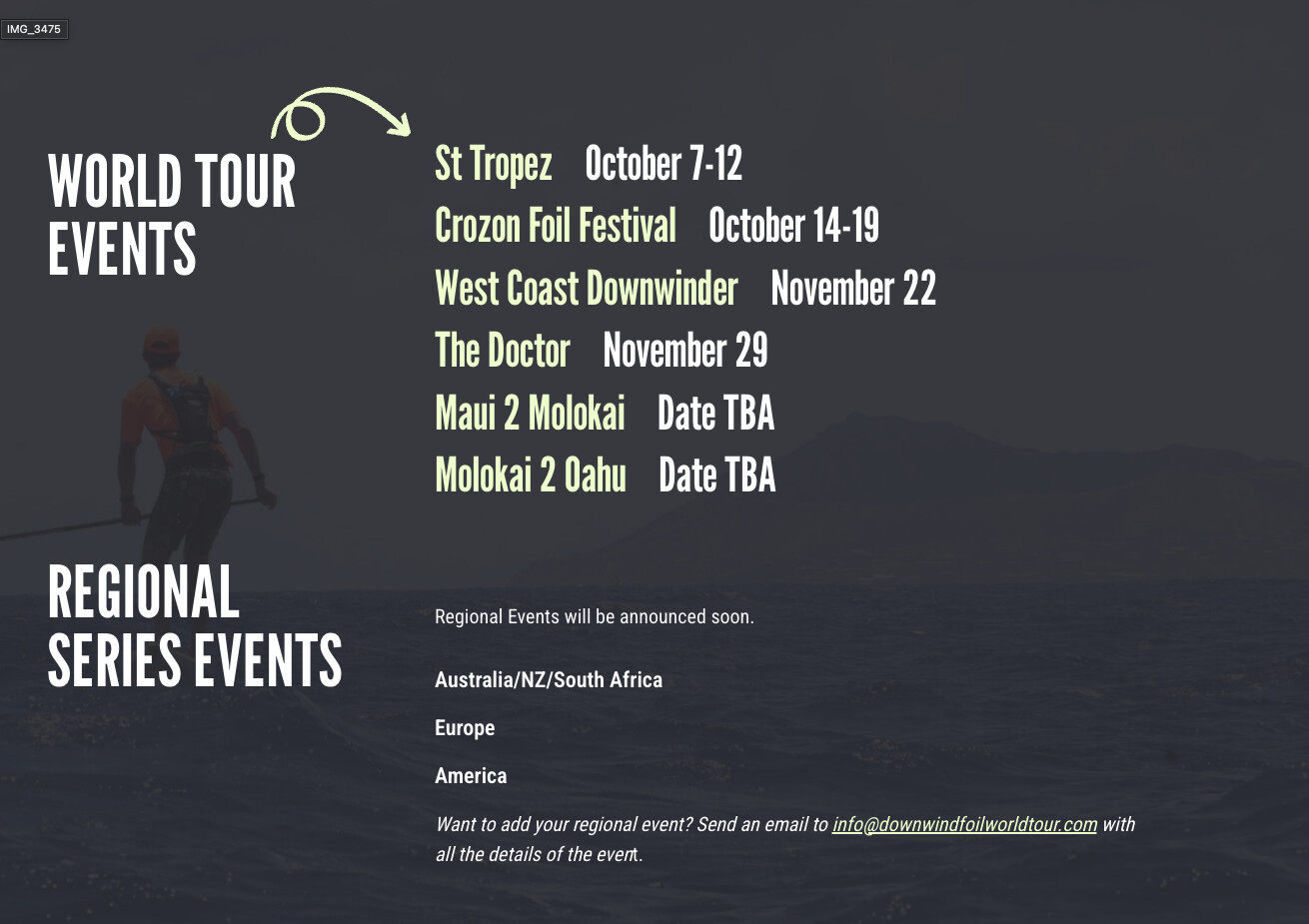
The World tour website is now live https://downwindfoilworldtour.com/
Hopefully something in the mainland US gets added, and an EU race that has reliable wind. Morocco, Tenerife, Tarifa all seem like good viable options in terms of guaranteed seasonal winds like you get in HI or Aus. Cape Town another great option.
It’s an interesting time for sure, the EU races have almost exclusively run in dead calm for a few seasons now, this leaves flat water pumping as a big part of it, like it or not, dock start and paddle up racing as a backup that becomes the main thing, like in SUP with the sprint races. Another run of high pressure and shifting calm for the French races confirms that, maybe Crozon gets lucky with a Sunday frontal weather going in their favour.
And the parawing does nothing to solve this light conditions issue.
But the parawing clearly is the dominant downwind discipline in terms of pure rider interest (and personally I feel like an unlock as a sport). Listening to the podcasts, there is hardly anyone outside the pros who is still solely paddling, which means fewer people who can even participate in light wind events. This is a risky situation for a coherent base of riders.
Lots of thoughts rolling around in my head for the Downwind World Tour…I think that the committee (which I am on) has done a great job getting the ball rolling, but more needs to be done and communicated. It is very difficult to get 6 people located all over the world to get together and create something that everyone agrees on.
I believe the most credible path forward for the Downwind Foil Tour right now is to focus on building a strong and transparent ranking system rather than creating a new championship title. A ranking-based structure gives riders a clear incentive to participate in multiple events, rewards consistency, and builds excitement throughout the season — all without undermining the world championship status that already exists and is respected across the community.
The M2O remains, and should always remain, the pinnacle of our sport — the ultimate test of skill, endurance, and ocean knowledge. Its legacy gives the entire sport credibility, and the tour should complement that by adding depth and context through a season-long ranking.
Looking ahead, I think it’s essential that we include more strong-wind locations — places that consistently deliver the kind of conditions our sport is built around. A “Dream Tour,” much like surfing once created, should highlight the world’s most iconic and reliable downwind venues. These stops need to be grounded in real communities that already host races, have passionate local riders, and can support the tour’s long-term vision. That’s how we build something authentic, aspirational, and globally respected.
First and foremost. One website to find the races and results. Linking to event websites is fine. But one place I can go, so I don’t have to endlessly Google where the results are without ever finding them.
Thanks for sharing, I agree with what you wrote
Some general thoughts that I intend to be constructive contributions as I’ve been wondering what takes this from an idea to a self-sustaining reality:
Incentives. Who is going to put in the “unpleasant job” type work to make this happen. For someone this will be a paying job, not a passion. Is there an organisation that can pay salaries. Do they own the IP to sell media rights. Someone needs to believe this can be the next big thing and put their energy into it. The novelty factor and self-motivated energy going into it feels like it could be enough to bootstrap and then commercialise (for better or for worse I guess)
Media. I don’t think this can be understated how media is now the single key driver of commercial viability of a sport, it’s tour, the profession etc. Big commercial sponsors are required, but they are looking at the timeline as an indicator of value, not the event itself. I would start at what should the media package look like and work backwards from that. Pro Riders should be required to participate in the media, interviews, vlogs etc. A 360 camera for everyone and a requirement to talk to it. Look at Netflix sports docu-series as the end-state and figure out how to get close to that.
This snippet below comes to mind as something I am starting to believe to be true.
There’s a new genre of company that is Timeline Native. Timeline Native companies are birthed on the timeline and exist more so on social than in real life. The narrative around the construction of the business is the core product. The widget or service which they produce is beside the point. The product is us being able to decide and announce if we are for or against the thing, to join a team and subsume a role as supporter
it’s an interesting time, credit to you guys doing the hard work and having the conversation.
Does anyone else think the invention of the parawing might mean the sport of DW Sup has already had its hay day in terms of participation numbers?
What happens if a large percentage of DW riding is completed by PW foilers purchasing completely different foils than those that the SUP DW foilers are sponsored to ride and market. Would the foil manufacture’s fly their riders around the world in support of the tour?
Maybe Parawing will just bring additional numbers to DW but for me I thought I would do both but after my first experiences on a midlength board I can’t go back. I can’t un-experience it and its removed my interest to SUP DW anymore. I know there will always be many foilers that want to race but I think parawing sort of splits the market.
Just thoughts.
What I see on my local spot, which has a pretty active downwind community:
So yeah, I totally agree with you. I think most of the people who really wanted to get into SUP downwind have already done it.
Since this summer, most newcomers who want to try downwind are doing it through the “shortcut” of parawing. And very few actually go for proper downwinds — most of the time they just stay close to the beach and 1 km downwinders”
Honestly, I even see a slight decline in pure SUP downwinders — between those who took the chance to drop the car logistics (and spend more time on the water) and those who simply enjoy the overall feeling of parawing more, without caring much for the racing aspect.
Yes, absolutely a risk, it has entirely sucked the enthusiasm out of paddle for intermediates in my area, very little interest.
I think the parawing is just a sensible path for newcomers because when it’s +20knots and the bumps are good, intermediates can experience downwind. When it’s 10 then just do something else has been my experience. Few real diehards are bothering when it’s miserably light, and that is 99% of the races, so the feeder ability to growing races is rapidly disappearing.
Which leaves a split:
parawing = intermediates
paddle = pros
So you can’t please both in one event, and I would imagine for downwind to grow, there needs to be some synergy between these two groups?
I think you’re confused. The only thing that matters is having top level athletes competing with global media attention like F1 or the americas cup. Never mind that the sport has no base, no connection to regular riders, no way for regular people to get together, do the sport, celebrate success, and have a beer in the car park after.
To be clear I think this focus on these crazy pro level races is INSANE. We need to look towards weekend sailboat club racing, local autocross racing, and amateur cycling - not the americas cup and f1. Anyone who actually does that stuff will tell you that the top end of the sport exists because of the bottom - not the other way around.
If this sport has any future it’s bottom up - not too down - event formats and locations to be inclusive of other gear(wing, PW, FD), cheaper to participate in, and just FUN TO DO. I think FSRL is on the right track except the actual race format SUCKS (the upwind leg, the pumping - I get it thsts the first format you thought of 5 years ago but maybe I’m he first idea isn’t the one we should be stuck with). Give me a format that resembles real foiling, downwind runs with your friends, riding back upwind in the back of a truck, send another on different gear if the first one didn’t work out.
@Matt — couldn’t agree more that the long-term success of something like this comes down to real structure, incentives, and storytelling. There’s passion right now, but eventually there has to be an organization with a clear identity, sustainable funding, and a media plan that brings people along for the ride.
Your “timeline native” point really nails it — this sport lives on the feed as much as it does on the ocean. In a perfect world it would be based on windy venues that produce amazing conditions and content. The right locations make the sport look as good as it feels, and having a ranking system that rewards riders for showing up at those places gives the whole thing legitimacy without forcing it into a “world champion” model too soon.
@FoilMad — parawing is amazing, I love it, but it’s never going to touch SUP when it comes to true channel crossings and open ocean racing. If you look at the current tour venues, at least half would either be too fickle, to rely on a parawing to get going again if you fall, or wouldn’t have enough wind to start at all. Personally, I’d never go unassisted on a channel crossing with a parawing and no paddle.
To me, both disciplines can thrive — @kezia parawing brings new people into the downwind mindset, and SUP keeps the deep-ocean endurance side alive. Also, Hood river is perfect for parawing, but most places are not. I live in Maui and love to parawing, but it has some major safety drawback here.
Great conversation. Thanks all!
Totally agree! I can never find the results I’m looking for!