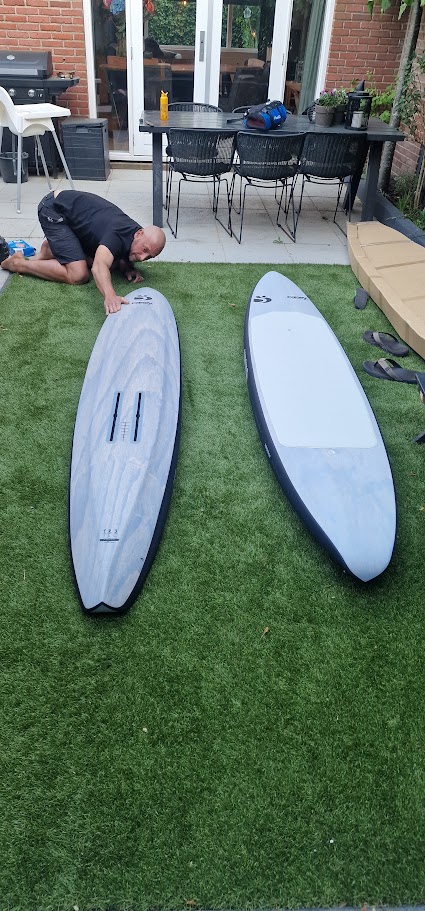
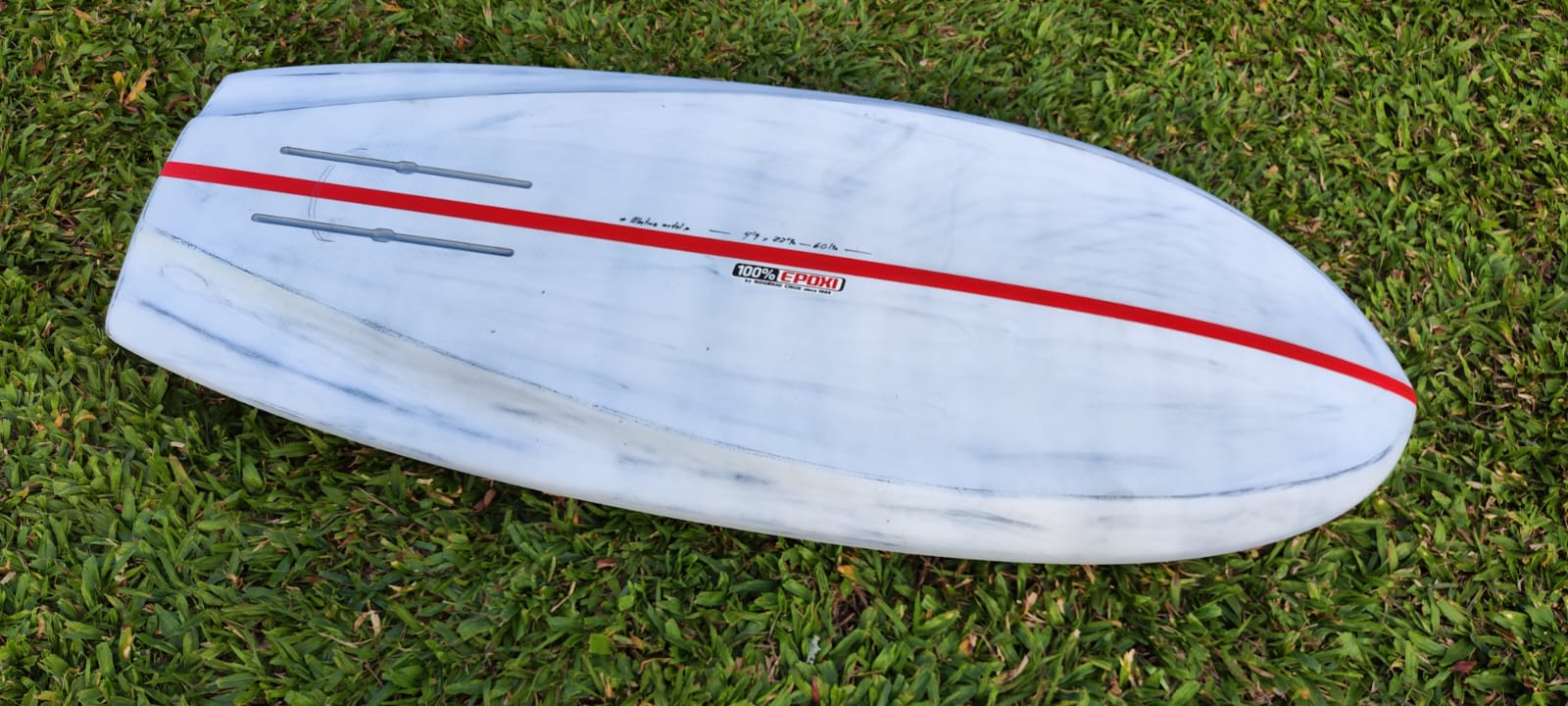
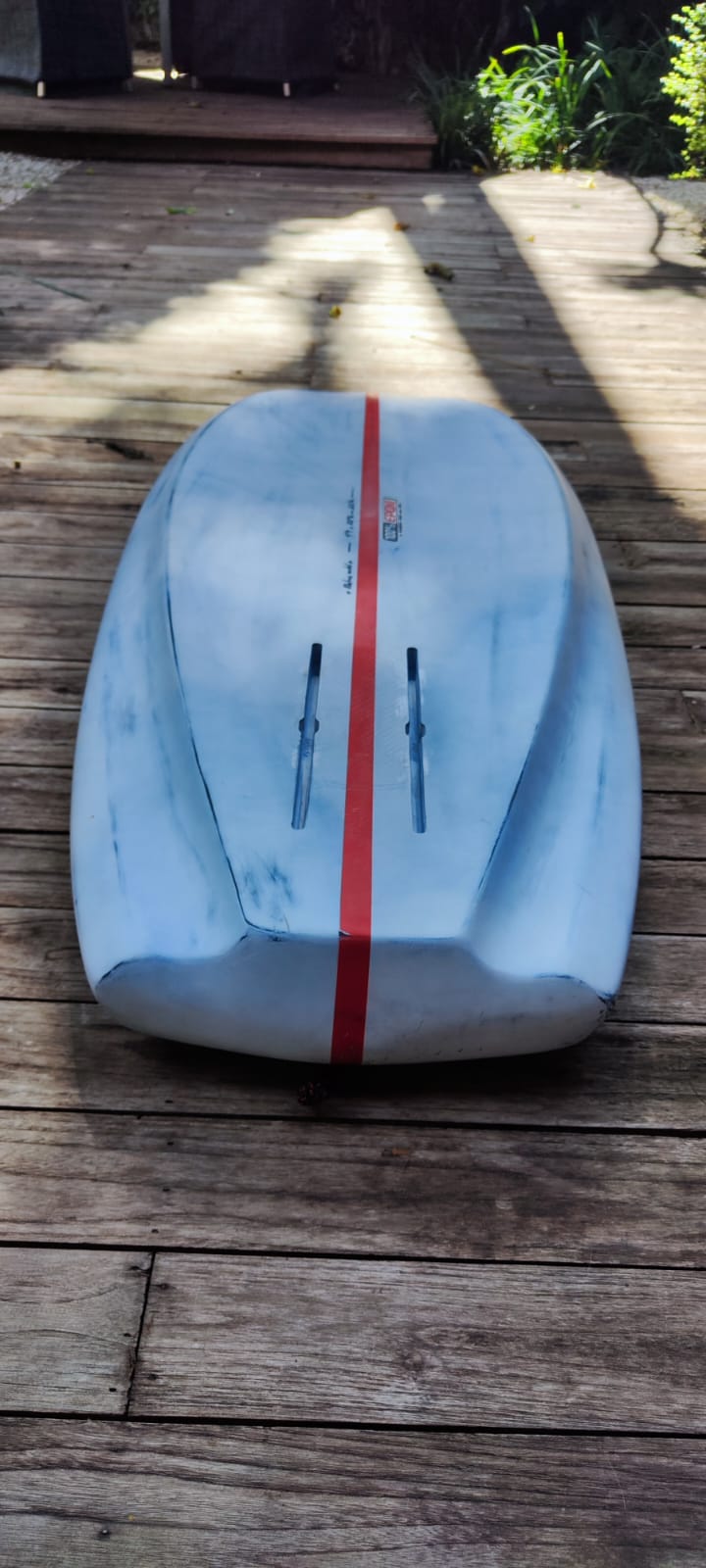
oh…and here is Gwen with his new Flying Fish:

oh…and here is Gwen with his new Flying Fish:
I think what is mostly missing is that most are still relying on thickness for volume, resulting in too much volume under foot. I guess the Gator design to some extent too as you lose some volume in the tail and that must be regained in the mid section.
I think a pure DW board should go for a deep dugout, and you stand directly on the mast. Once you are beyond intermediate the compromise is surely worth it
Amos Bullet V2:
Appletree V2 is out now. I have a custom 7-7x18 100L proto. Its a great shape, and significantly lighter than my 100L V1 was:
My quick (obvious) read on the two major themes across a bunch of these boards:
Still a variety of hull shape strategies…but of course, every one claims that X feature of their board “allows for better release” and/or “makes the board faster”
I got my sunova aviator 8.4x20x125 this week and the board looks stunning and very made.
I can supfoil in the waves but know hardly what i,m doing on a DW,  but the lines on the board looks logical to me
Buddy Marco is inspecting his 8.8x17.5x115l
Looks like sunova is sticking with normal nose rocker, I still think high nose and tail rocker slows the board but maybe help with stability?
Good to hear, Erie…I have a 7’8"x18, 105 on the way…Stoked!
picking up my 8x18 this week!
Would love to hear some more opinions/thoughts on this point
A deep dugout presents some challenges. The dugout well fills up with water which is really heavy and takes several moments of paddling to bail out. The other challenge is when you fall smashing into the dugout sides is painful, but also cracks the sides, and you’ll likely break a few paddles. I have done all of the above multiple times on non-foiling dugout sups. The difference is you fall less on a non-foiling SUP.
Would those issues apply to a pro? I doubt it. The dugout itself was a novelty for SUP when first presented, likely for the same reasons
Dragonfly 3
I like the built in angle (the same + shim that I shim all my high aspect foils)
Also like the consideration for crosswind aerodynamics, as I really started to notice that in 30kn +

Hi @Velocicraptor I did a 5’x 21" 60L with this idea (I saw a AFS board like this) and would say that helps to take off
That was a nice video except I don’t think I saw the board actually in the water being paddled up. It’s all good showing how they fly above water but a bit incongruous with all the discussion being about how the shape helps you in the water.
I think this is generally a good summary of the way things are going, with some variations on the specifics but generally the trend.
AFS added to the list of refinements following that trend, though that massive W concave through the nose is pretty unusual
That’s Starboard and KT with hollow boards, I guess all the COBRA International customers will be able to use their hollow construction. I wonder if it only makes sense for downwind shapes or if that’s just where the customers willing to spend enough money are right now.
It is also looking like KT and Appletree are going with harder/longer chines and flatter bottoms than the last iteration, while Armie is going more rounded (at least in the rails ???). Armies claims of the rounded rails adding stability is interesting…It sounds like they are thinking about that in terms of the motion on the water in waves being smoother (?). From sailing, perhaps, a more “sea kindly” motion, even if less “stiff” in terms of initial stability…
Hollow boards win when surface area to volume ratio gets below a certain ratio. The hollow board deletes the weight of the blank, but increases the weight of the skin.
A small thin low volume prone board is never going to benefit from hollow construction because it has too much skin area and the blank isn’t that heavy to start with.
But the narrow, thick, long downwind boards are perfect for hollow.
A really light and strong enough composite skin for a hollow board might be 2 layers of carbon, 10mm nomex honeycomb, and 1 layer inside. Maybe around 1500 gsm (gram per square meter).
Compare that to a typical lightweight skin layup on a 28kg/m3 blank which might be closer to 800gsm.
So a 115L board has surface area close to 2 square meters built on a foam blank that weighs 3.2kg and skin weight is around 1.6kg for a total mass without deck pad or foilbox of 4.8kg
Build it hollow and the mass without deck pad or foilbox can be 3kg. Maybe under 4kg with the foilbox and deckpad.
10mm Nomex honeycomb is pretty expensive. If you use 5lb PVC foam sheet instead to keep costs in control, add another 300gsm to the skin, or .6kg to the board
A 2 layer skin is going to be somewhat fragile. once reinforcements are added weight is going to go up more. Production boards can’t be so fragile or warranty costs skyrocket. It may be difficult to get a hollow board into production for this reason in reality.