Back to building a theory of “why” they/he keeps using them, at a real cost to their manufacturing:
Is it for Hard carves?
I don’t have much of an idea around how high the Angle of Attack (AoA) in carves actually is. I feel like AoA is possibly not that important in carves, or for high speed stability.
I can fully appreciate the feeling for low speed pumping in aerated water, where one has to be very careful not to let the AoA get too high at any point.
When doing a hard carve, it is exactly the opposite. I know that I can push that foil as hard as I possibly want, and that inertia will accelerate me and so I can drive the foil through the water even faster.
So, I’m not that sure these tubercles have much impact at high speed, based on the idea that the foil is probably quite flat during high speed carves, and if it isn’t (in an extremely tight pocket carve link turn), then inertia will accelerate the foil.
Questions left with:
- What do they do at high speed?
- Is the high AoA ventilation prevention that useful for carves?
My intuition / current understanding is probably not much / not really for these questions.
I currently resonate the most strongly with the idea that they create “fences” preventing ventilation, increasing stall recovery, and helping with tip breach performance.
Here is why:
First - what they do
Key points, the following appears to be true:
- Tubercles prevent stalls and ventilation from moving inward from the tips
- At a higher Angle of Attack, the effect is stronger (citation?)
Second - what the designer has done
You will also notice that gen 1 Kujira (bottom right) had the tubercles on the wing tips, and were relatively smaller. All subsequent foils have them starting 1/3 from the tips, and concentrated around the primary lifting area.
This change, to me, is the best clue as to why they have persisted, and what the purpose is:
- They are creating a strong series of “fences” near the primary lifting area (the middle)
- This preventing as much as possible the onset of flow separation
- If ventilated, reduce the persistence of it in that area (to recover from a full stall breach),
- This effect is more pronounced at high AoA (or through turbulent water?)
AFS left, Takuma right
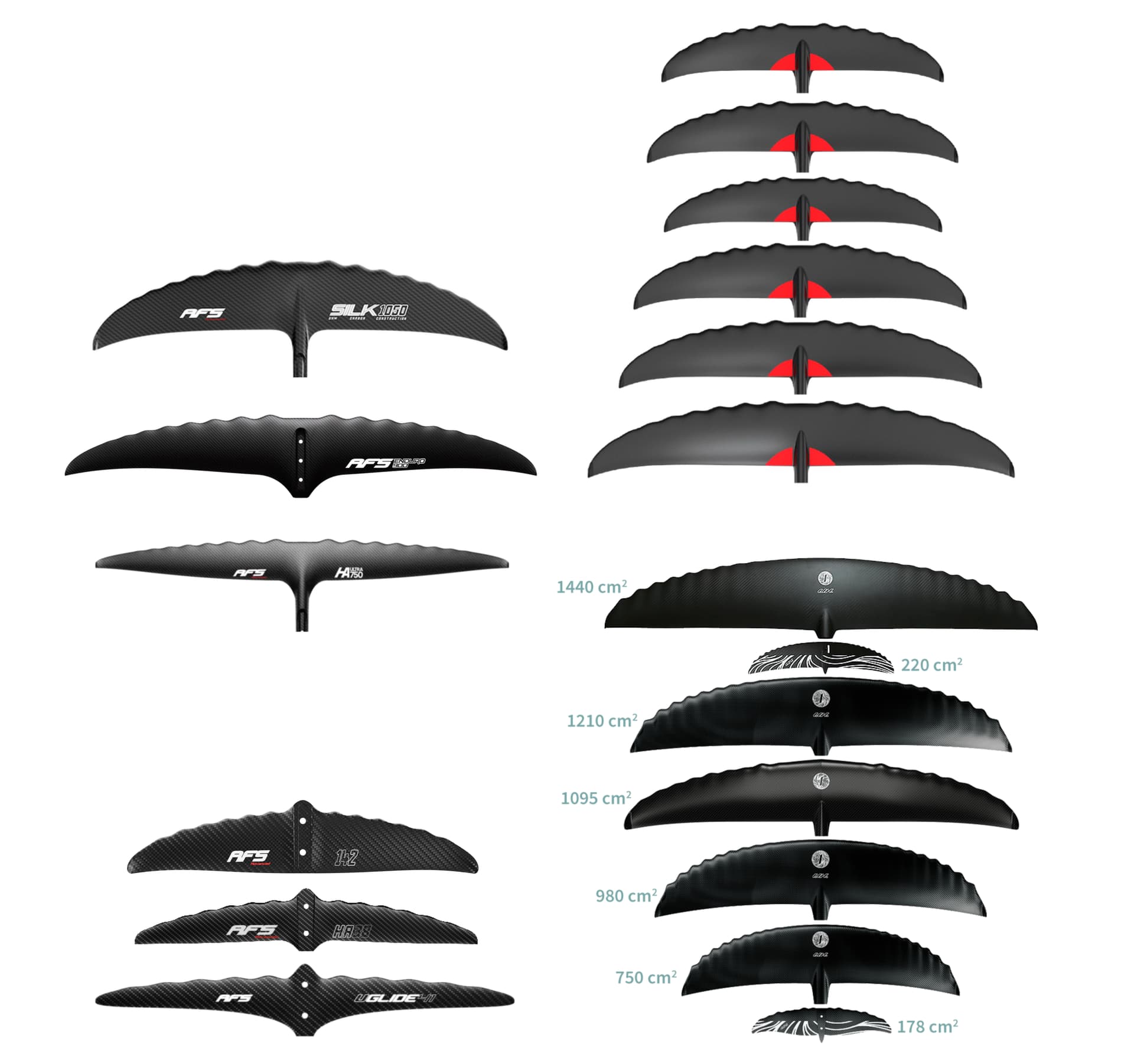
I’ve also noticed that on the Enduro 1300, I can recover from a very flat breach more often than not. The wingtip ventilates, I drop down a bit, but if I anticipate it, I can catch it easily. Compare to 1201, where this was mostly impossible to recover. Similar on Ultra and Silk, but to less directly comparable degree.