My man, glad someone gets it 
Basically you just buy a new nose cone depending on whatever is trending that year
My man, glad someone gets it
Basically you just buy a new nose cone depending on whatever is trending that year
YUP! DO IT!!
4 years ago I drafted this picture. Essentially putting an Axis tray board, thin dockstart board, into a skirt of a larger board. In my case I was going to build a downwind board.
The tray board could be hot-swapped into multiple skirt designs; downwind, wing, parawing (didn’t exist then), prone, boogie (blah!!!).
The board I built was out of XPS foam, because it was waterproof, and didn’t therefore need any significant lamination. Light in the ends, just foam with enough fiber, 1.4 oz glass, to keep from flecking away.
The board ended up 7’ 10” x 21”, 9.75 lbs @ 128 liters. It was 7.6 lbs / 100 liters and to date no one in the world has posted anything lighter (lbs / liter). Similar concept but not modular. Strong under the feet and robust box reinforcement. Built 3+ years ago and no hollow board, no production board, no custom board (that anyone has shared) has been lighter. Crappy XPS and my first build. I thought it might last 30 sessions.
I used the board, The Sailfish, a month ago and it was still working 190 sessions later. Boxes installed with the carbon arrow method above.
Granted it had gained weight, from the addition of material where it had signs of wear. But its still alive. I think its @ 10.75 lbs now.
Beasho - I remember some of this discussion back in the good old days of that other forum. I’ve also followed pretty closely some of your board builds. Just to be clear - did you ever try building something like this with the “cassette + hull” concept?
I’ve also thought for a long time this build method could be very promising. And even for the hollow board builds, I’m not a huge fan of what’s shown on the KT videos with all the bulkheads to stiffen up (obviously it works really well, so they’re doing something right!). I think the super stiff tray/cassette standing area with stiff/strong linkage to the foil box(es) with very lightweight hull structure would yield the best performance
My 4’10” prone is solid Divinycell with internal reinforcement and 2x carbon all around. Definitely heavier but the stiffness and power transfer are insane! I think for prone shapes weight is almost irrelevant - it being so compact and seeing what people do on bigger DW shapes that are heavier with the weight more spread out.
i would say make the central stiff section out of solid D cell and the rest of it Maybe even like an un-glassed fused EPS product. I played atound with the idea some but at the end of the day I’m 90% prone and don’t care enough about bigger boards to Invest the time and energy into it.
I was thinking the stiff section would be like a trapezoid shape , baseplate size on the bottom and stance sized on top and make it geometric for easy CNC cutting. Don’t make it go to the rails cause they don’t need to be stiff and it would allow the stiff section to slot into more different boards.
Yeah this is what I was thinking. I keep wondering what an optimal internal structure would look like, I think some crystalline thing. Maybe additive manufacturing gets there and you can 3D print an HD foam board with optimised internal structure like this crew with their fancy titanium crystal structures which I guess you could possibly get an elcheapo version of
Also interesting to see the guts of an Armstrong and Amos
Oh baby, I love seeing the guts of boards! Can somebody please cut open a portal… For science!
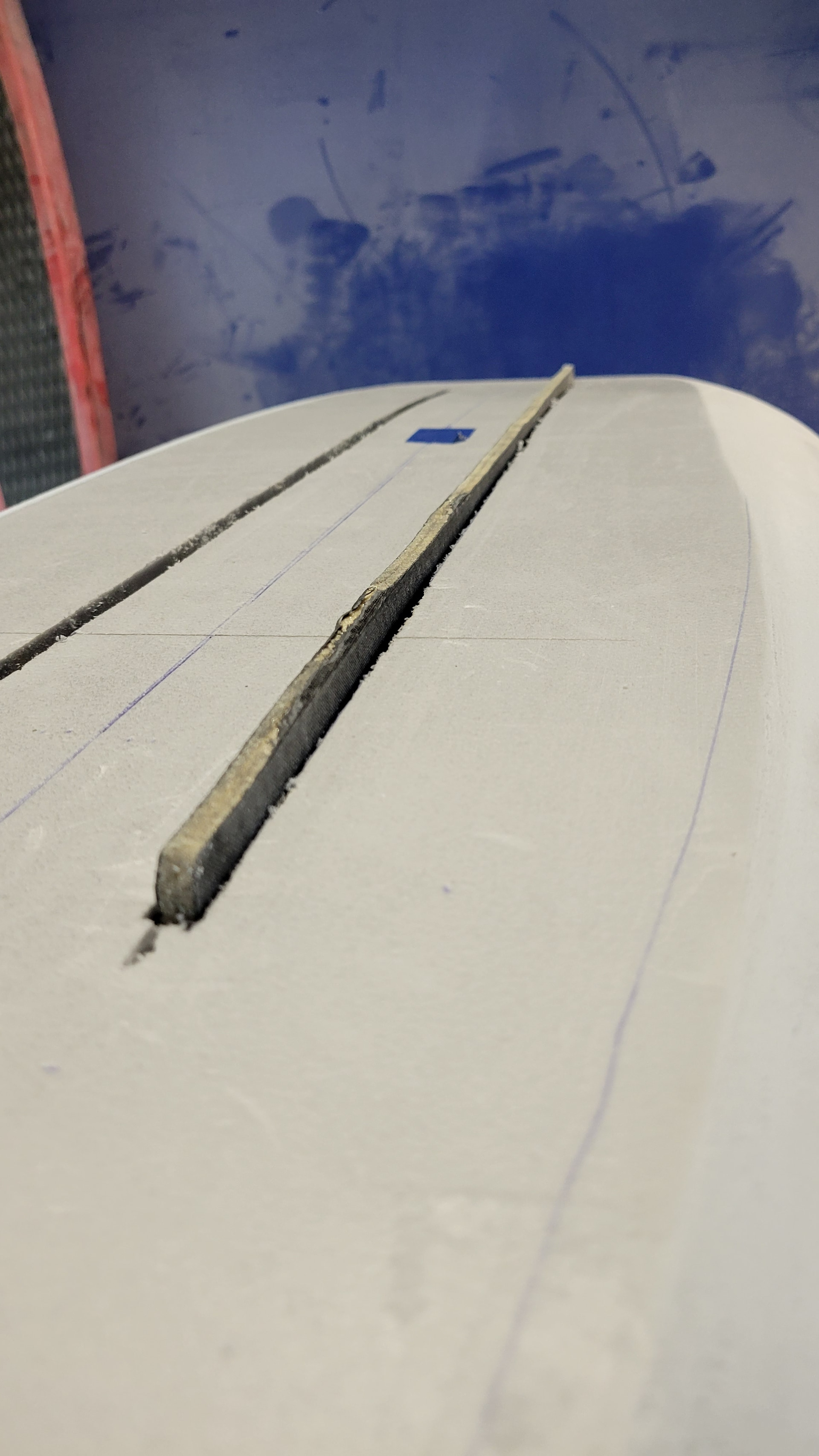
I had some leftover 3mm HD foam and carbon. So here’s is what I’ve done on my last parawing board : A casette and 2 stringer that run from the track to my frontfoot. The stringers goes from the bottom to the deck.
So I glued the foam together and then vacuum bag some carbon to make a sandwich panel (6.8 mm final thickness). My 3" long router bit is 5/16"(7,8 mm) in width, so the cut is pretty easy to do. You just need a straight edge to butt the router against and one pass for the cut. I then use a hand saw against the slot wall to cut to the other side of the blank.
The weight of the stringer is the same as 3/4 thick 80 kg/m3 HD foam stringer but I assume much stiffer.
I don’t know if I’m gonna feel a difference but It was a nice project to work on. Especially because the material was salvaged from other build.
This looks fantastic! Should hold well.
The only caveat that I have is the joint between the boxes and the top of your laminated stringer. Could be some odd stress risers. But this is off set by 16" tracks. Those distribute load way better than 10" tracks, the see saw effect, and load up front of box is mitigated significantly. Also are the bottom of those tracks dead flat??
I think wingboards need to be the most durable, then maybe thin prone boards, because the i-beam effect on the board is reduced by the thinness of the board.
Downwind boards have a particularly nasty lifestyle that include pumping and big foils rocking back and forth.
There have to also be WAY, WAY more box failures than people like to talk about.
The main issue with this idea is the connection between the strong part to soft part,
you lose a lot of stiffness in the connection and that can be significant
Look on this inflatable board , super stiff and strong connection plate in the standing area , but you can guess the preformance…
I don’t understand what you are saying? that starboard idea is great, it’s pure carbon between your feet and the foil? (the board is another story)
in my diagram there is no soft part, it’s all hard
The issue never ends,
You make make super strong and stiff box around the standing area , doesn’t matter from what material.
The next weak point will be between the stiff standing area to the rest of the board ,
And it will be either soft/webbling (even if use carbon ect..) or it will break just in front of it
I still haven’t seen the perfect foilbox solution to solve all issues that you raised,
But at the moment the Hollow boards construction give the best solution so far
I am not sure I understand correctly. Are you talking stress from on a pitch or on a roll plane ? Am I seeing this correctly ?
My thinking behind the stringer was :
And yes, the base of the fin box are dead flat. On futures boxes, its the top part that is curved to accomodate for rocker on longboards tails .
Cheers !
Ahhhhhhhhhhhh! That’s just solved a long running mystery for me! I thought I was bending them slightly during the process and could never work that out. Thanks dude 
So glad this thread is here. I stress about this whenever I build a board. Here is what I’ve got going on right now. Different than everyone else since it’s a hollow wood board but I’d love to hear thoughts. If you all don’t think it’ll work, let me down easy since I already glued the blocks in. It’s similar to a wing foil build I did a few years back and that held up.
I initially wanted two stringers. One extending from each box, but was convinced to try with the one center one.
Efoil builders have used this (crude) inflatables.
The battery and standing area nest inside,guess with a shape that overlaps top and bottom.
I have long imagined this concept with well designed and built inflatable shapes (like Gongs latest superlight boards) and a simple pump board to nest in them.
You could go on a trip with 2 or 3 boards ,including a +8feet DWnder and normal sized baggage.
Weight/Inertia would be OK i think with most of it very well placed close to mast.
Could take some iterations to get right but maybe someday we will see it.
Unfortunately inflatable tech is not for us DYers…
I’ve long thought about (and others have posed it too, not only my idea) a foil cassette system which is basically a thin but super stiff and light pumpboard. Then you could attach any number of different inflatable or even light foamie “boards” under it. It could become a prone, midlength, or downwind board and for all it will be very stiff transfer of energy from feet to foil. I personally think it is possible it could result in if not a lighter board, at least a lower inertia board in the tips and tails.
Another idea of note is something I heard about but not yet seen. There is a board builder in the SF bay area who apparently made a board with the plate mast bolted from top down. It is placed through a slot in the board and attached to a recess in the deck from above. And I guess you would put deck pad on the mast plate to stand on. Pretty sweet idea.
Interesting concept,i am.no engineer but i think removing thickness has a huge effect on rigidity.
Think of our boards as a cantilever structure with foam instead of uprights and diagonals.We have learned to reinforce that foam cantilever with carbon tubes or wood because the foam.by itself is not that good at repeated load cycles.
If you make the board thickness on top of the mast thin as a plate it wouuld need huge reinforcement to work ,and that means weight.
I think an inflatable carbon plate is 7mm thick (solid fiber) to withtstand the lever forces.
A +10cm thick “pump” base board could be just as rigid with a lot less weight.
yeah, maybe not as thick as 10cm, 5cm might be enough. But yes, whatever is the lightest deck structure. I generally think whatever is working best for the dockstart pumpfoiling folks is a good starting point